Rust cheats explained through a private cheat menu showcase that shows exactly what ESP, aimbot and customization options look like in a live server
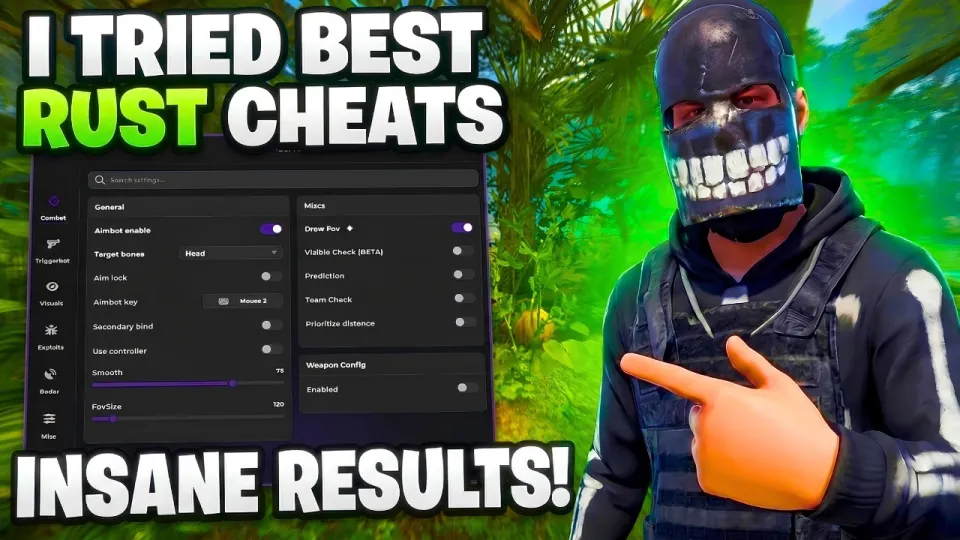
Video: I Secretly Used Rust Cheat To Dominate Everyone In The Server...(INSANE)
· based on the channel yqzkqrv
Key takeaways
- The showcase features the ZALIANT Private Rust Cheat, sold through zaliantservices.com.
- The video runs through four chapters: menu showcase, features overview, gameplay and a final review.
- Rust cheat menus typically group modules into ESP, aimbot, misc and settings tabs.
- ESP modules usually cover players, loot, containers, vehicles and stash markers.
- Aimbot modules are configured with FOV, smoothing, hitbox priority and visibility checks.
- Private (application-based) cheats are sold in limited slots rather than as open subscriptions.
Rust cheats are third-party software modifications that inject an overlay into the game client to add features such as ESP (player and loot tracking through walls), aimbot, and recoil or movement helpers. A private cheat of this type is what the yqzkqrv showcase walks through: the ZALIANT Private Rust Cheat product page is where the software shown in the video is sold, and the footage covers its menu, its feature list, its settings and a short gameplay segment on a live server.
What the Rust cheat showcase actually covers
The video is short and structured rather than a full tutorial, and it is split into four chapters: an intro and menu showcase, a features overview, a gameplay showcase, and a final review and outro. That structure matters if you are evaluating a cheat, because it tells you what you can and cannot judge from a clip.
What you can see: the layout of the menu, the names of the modules, the sliders and toggles attached to each one, and how quickly the overlay is opened and closed in-game. What you cannot see: the detection status of the build on the day you watch it, the behaviour of the software after a Rust update, or how the seller handles support requests. Treat the video as an interface tour, not as a guarantee.
The modules you will find in a Rust cheat menu
A Rust cheat menu is normally organized into tabs, and the four you should look for first are ESP, aimbot, misc and settings. The exact naming varies by provider, but the underlying categories are stable across the market.
- ESP / visuals. Player boxes, skeletons, health and distance readouts, plus world markers for loot, crates, containers, vehicles, dropped bags and stashes. Most menus let you filter by item name and set a maximum render distance so the screen does not turn into noise.
- Aimbot. Target selection by FOV, hitbox priority (head, chest, nearest bone), smoothing and humanization sliders, and a visibility check so the aim only snaps to targets you can actually see.
- Misc. Everything from no-recoil and no-sway to faster crafting menus, silent loot pickup radius and movement tweaks. This is the tab that most often contains the features that get accounts flagged fastest.
- Settings / config. Keybinds for opening the menu, per-module hotkeys, colour themes, and save/load profiles so you can switch between a subtle and an aggressive setup.
A private cheat usually adds a loader on top of this: you run an application outside the game, authenticate with a key, and the software handles injection. That is a different delivery model from a plain DLL you drop into a folder, and it is the main reason private builds cost more.
How ESP and aimbot settings change the way a raid plays
ESP is the module that changes decision-making, not just aim. Knowing where a player is standing inside a monument, or that a crate has already been opened, removes the information-gathering phase that makes Rust slow. In the showcase footage the overlay is used to move between fights rather than to stand still and shoot, which is the more common way these tools are actually used.
Aimbot settings are where most users get caught out. A high FOV with no smoothing produces obvious snap-aim, and Rust's gunplay — with projectile travel time, bullet drop and pattern-based recoil — punishes settings that ignore those mechanics. Sensible configurations keep FOV narrow, use smoothing values high enough that the crosshair travels rather than teleports, and enable a visibility check so the aim does not lock onto players behind cover. Recoil control is a separate module in most menus and is usually the one that looks most suspicious in a spectator review.
Detection risk, pricing and what private actually means
No cheat is permanently undetected, and any storefront claiming otherwise is selling you a snapshot in time. Facepunch ships anti-cheat updates alongside game patches, and a build that works on the day of a showcase can be down for days after a forced wipe. Before buying, check three things: when the product was last updated, whether the seller publishes a status channel for downtime, and what the refund policy says about detection bans.
On price, private Rust cheats sit at the top of the market — typically a monthly or multi-month key rather than a one-off purchase — because access is limited and the loader is maintained per user. Cheap public cheats exist at a fraction of the cost, but they are also the builds that get signature-detected first. The ZALIANT product shown here is positioned as a private, application-based cheat, which is the segment the video is demonstrating.
Where to find the software and community links from the video
All links referenced in the showcase point to the same seller, and the order below matches the video description:
- ZALIANT Private Rust Cheat product page — the specific product used in the footage.
- ZALIANT store — the full catalogue of products from the same seller.
- ZALIANT Discord community — support, status updates and announcements.
If you are comparing options, use these as a starting point and check the update log and status channel before spending anything.
Summary
The yqzkqrv showcase is a compact look at a private Rust cheat: a four-chapter run through the menu, the feature list, the settings and a short gameplay segment, built around the ZALIANT Private Rust Cheat. The useful takeaway is not the footage itself but the checklist it implies — ESP filters, aimbot FOV and smoothing, recoil modules, update cadence and ban policy. If you want to inspect the product from the video directly, the ZALIANT Private Rust Cheat page is where it is listed, and the channel yqzkqrv is the author of the breakdown if you want to see the menu layout in motion before deciding.
Questions & answers
What are Rust cheats and how do they work?
Rust cheats are external programs or injected overlays that add features the base game does not allow, such as seeing players through walls (ESP), automatic aim assistance, and recoil or movement adjustments. Most private builds use a loader application that authenticates a key outside the game and then injects into the Rust client, which is why they are distributed as limited-access products rather than open downloads.
Are Rust cheats undetected?
No build is permanently undetected. Facepunch pushes anti-cheat and game updates regularly, and any cheat can be down for hours or days after a patch or forced wipe. Before buying, check the product's last update date, whether the seller runs a public status channel, and what the refund terms say about detection bans.
What settings matter most in a Rust aimbot?
FOV, smoothing and hitbox priority are the three that change both performance and how obvious the software looks. A narrow FOV with high smoothing and a visibility check behaves far more naturally than a wide-FOV snap, and Rust's projectile travel time and bullet drop mean the aim module also needs to account for lead and distance.
What is the difference between a private and a public Rust cheat?
A private cheat is sold in limited slots with a per-user loader and is maintained by the developer for that smaller group, which usually means slower signature detection but a higher price. Public or cheap cheats are sold in volume, are cheaper, and tend to be the first builds hit when anti-cheat signatures are updated.
Source: I Secretly Used Rust Cheat To Dominate Everyone In The Server...(INSANE) · Markdown version